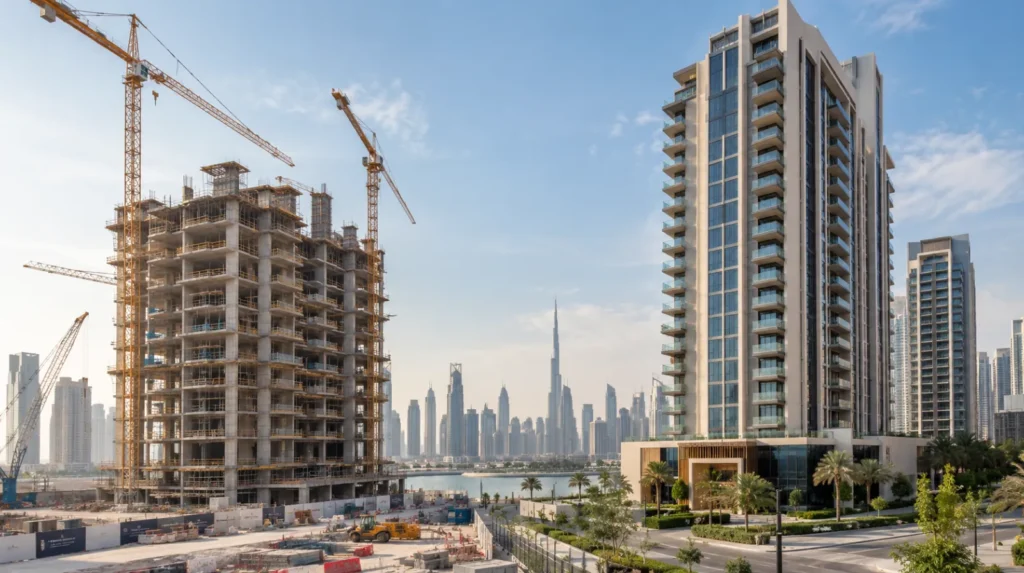
If you are buying off-plan property in Dubai, the smartest starting point is not the brochure or the payment plan. It is verification. Before you commit, you should confirm that the developer is approved, the project is registered, the project has an escrow account, and the actual construction status matches what you are being told. Dubai Land Department gives buyers official tools for exactly these checks, including Licensed Developers, Verify License and Permits, Project Status Enquiry (Mashrooi), and Dubai REST.
Key Takeaways
- Dubai Land Department has an official Licensed Developers service that lets buyers view developers approved by the Land Department.
- DLD also provides Verify License and Permits through the Trakheesi system so buyers can check licenses and permits issued for real estate activities practitioners.
- Under Dubai’s escrow law, a developer selling off-plan units must open a separate escrow account for the project, and buyer and financier funds must be deposited into that account.
- DLD’s Project Status Enquiry and Dubai REST let users check project completion percentage and details, and Dubai REST also shows actual project photos and the escrow account number for off-plan projects.
- DLD’s investor guide specifically recommends checking the escrow account, completion percentage, expected completion date, developer registration, land ownership/development agreement, and whether the developer has the required DLD/RERA approvals to sell off-plan.
Start with the Official Checks, Not the Sales Pitch
A buyer does not need to guess whether a Dubai off-plan project is legitimate. The official system already gives you a practical verification path.
| What to check | Official tool | What it helps confirm |
| Developer status | Licensed Developers | Whether the developer appears on DLD’s approved developer list |
| License / permit validity | Verify License and Permits | Whether relevant licenses and permits can be validated |
| Project progress | Project Status Enquiry (Mashrooi) | Completion percentage and project details |
| Live off-plan data | Dubai REST | Completion %, actual photos, escrow account number, payments due |
This is the most useful first filter because it separates marketed projects from verifiable projects. A project may look polished online, but the real question is whether its legal and technical footprint appears properly in DLD’s ecosystem.
Escrow Is Not a Detail. It Is One of the Main Safety Checks
For off-plan buyers, escrow is one of the most important checks in the entire process. DLD’s investor guide explains that developers intending to sell off-plan units must open a separate escrow account for the project with a DLD-accredited escrow agent. The same guide says that all amounts paid by purchasers of off-plan units, as well as relevant financier payments, must be deposited into that account, and that those funds are allocated exclusively to the construction of the project and settlement of project financing in accordance with the law. It also states that project escrow accounts are regularly audited and monitored by RERA’s Real Estate Escrow Account Division.
Before you buy, ask for:
- The escrow account number
- The name of the escrow account agent
- Confirmation that the project is registered for off-plan sales
- Evidence that the project you are buying into is the same one reflected in the official records
If a project is being marketed but escrow details are unclear or cannot be verified, that is not something to overlook.
Check the Project, Not Just the Developer
Even a licensed developer is not enough on its own. The specific project must also be checked. DLD’s Project Status Enquiry service allows users to inquire about real estate project completion percentage and project details in Dubai. Dubai REST goes further for off-plan beneficiaries by showing real-time project information, including completion percentage, actual project pictures, escrow account number, and payments due.
That matters because delivery risk usually shows up at the project level first, not the branding level.
Use project-status tools to compare:
- Claimed completion versus official completion percentage
- Sales presentation versus actual project photos
- Claimed payment stage versus payments shown in the system
- Whether the project’s escrow details are visible and consistent
This is often more useful than asking vague questions about whether the project is “on track.”
Make Sure the Project Is Legally Ready to Be Sold
DLD’s Know Your Rights guide is especially helpful here because it lists the exact questions buyers should ask in off-plan cases. Among them:
whether there is an escrow account for the project, what the completion percentage and expected completion date are, whether the developer is registered with RERA, whether the developer owns the development land or has a development agreement, and whether the developer has the required DLD and RERA permits and approvals to sell off-plan units in that project.
That same guide also states that developers must obtain the required approvals before launching, marketing, and selling off-plan units, and that any sale or disposal made before the requisite approvals are issued and before the project is registered with DLD is considered null and void.
The practical legal checklist is:
- Is the developer registered?
- Does the project appear properly in DLD systems?
- Is there a valid escrow structure?
- Are the permits and approvals in place?
- Does the project appear to be legally marketable, not just commercially advertised?
How to Think About Track Record and Delivery Risk
Track record is where many buyers become too impressionistic. A brand name, a showroom, or a polished campaign does not tell you enough on its own. A better way to assess delivery risk is to start with what can be verified officially, then judge the commercial story around it.
A practical way to assess developer reliability is to ask:
- Is the developer approved on DLD’s list?
- Is the project visible in official project-status tools?
- Do the official completion figures support the delivery claims?
- Are escrow details clear and consistent?
- Are the necessary permits verifiable?
That will not answer every commercial question, but it will help you avoid one of the biggest off-plan mistakes: trusting marketing language more than official project data.
Final Thought
The best way to check a Dubai off-plan developer is not to rely on one signal. It is to combine four things: developer approval, permit verification, escrow verification, and real project-status evidence. Dubai already gives buyers the tools to do this. The more closely a project’s official records match its sales story, the more confidence you can have in what you are buying. The wider that gap becomes, the more careful you should be.