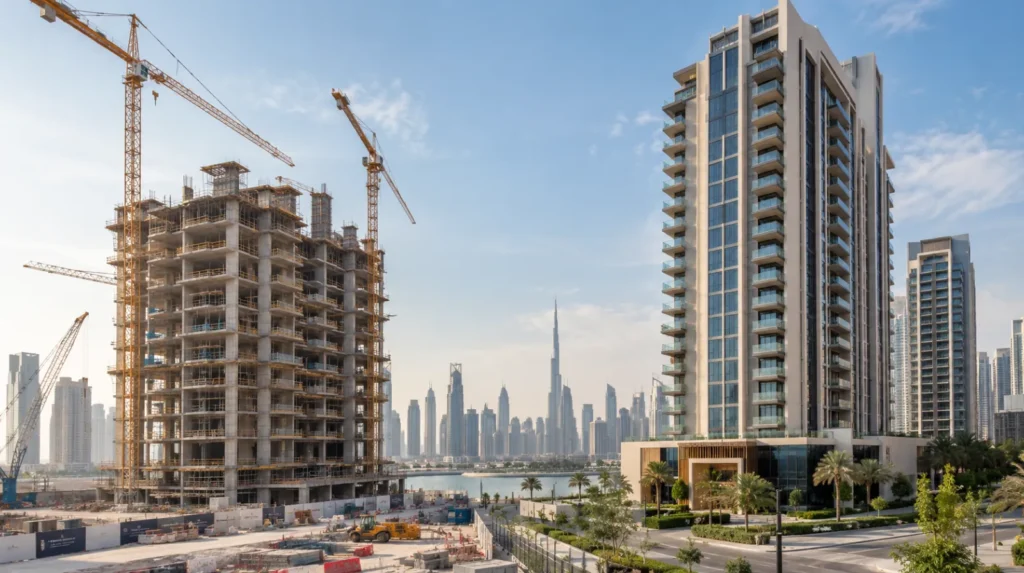
If you are buying property in Dubai as a foreigner, the process is more structured than many buyers expect. For a standard ready-property purchase, the practical path usually runs from an offer/reservation stage, to the sale agreement, to developer clearance, and finally to registration through a Real Estate Registration Trustee office, where the electronic title deed is issued. If the property is off-plan, the path is different and goes through initial registration / the provisional register rather than immediate title transfer.
Key Takeaways
- In Dubai’s broker framework, Contract B is an agreement of desire to purchase between the buyer and the broker, while Contract F is the agreement to sell between the seller and the buyer.
- For a ready-property transfer, DLD’s sale registration service requires a valid passport for non-resident foreigners and an e-NOC from the developer in freehold areas.
- DLD says sale registration is handled through Real Estate Registration Trustee offices and lists a service time of 20 minutes for the registration step itself.
- The issued outputs for a completed transfer are an electronic title deed and an electronic map.
- For off-plan purchases, the developer registers the sale in the provisional register, and the output is a provisional registration e-certificate, not a title deed.
Step 1: Start With the Offer and Reservation Stage
Before the title deed stage, there is usually a negotiation and commitment stage. In Dubai’s official brokerage framework, Contract B is defined as an agreement of desire to purchase a property between the buyer and the real estate broker. That makes it a useful reference point for the early “reservation” stage, even though buyers often describe this phase more casually as making an offer or reserving the unit.
| Early-stage contract | What it does |
| Contract B | Records the buyer’s desire to purchase through the broker |
| Contract F | Records the sale agreement between seller and buyer |
The important thing here is not the label alone. It is understanding that Dubai’s system distinguishes between the early buyer-intent stage and the actual sale contract stage.
Step 2: Sign the Sale Agreement Properly
Once the deal terms are agreed, the key sale document is Contract F, which DLD’s brokerage guide defines as the agreement to sell a property between the seller and the buyer. The standard sale contract template shows that the buyer may pay a deposit/security cheque at signing, while the remaining balance is paid by manager’s cheque or another guaranteed method acceptable to Dubai Land Department. The same template also states that the seller undertakes to complete the transfer to the buyer’s name after receiving the agreed price.
What usually gets fixed at this stage:
- Sale price
- Deposit/security amount
- Payment method for the balance
- Transfer deadline
- Any additional agreed terms between the parties
This is the stage where the transaction moves from interest to obligation, so clarity matters much more than speed.
Step 3: Get the Documents Ready for Transfer
For a standard ready-property sale, DLD’s sale registration page is very clear about the core documents. For individuals, the process requires Emirates ID for identity verification or a valid passport for non-resident foreigners, plus an e-NOC from the developer in freehold areas through Dubai REST.
Core transfer documents for individuals:
- Emirates ID for identity verification, if applicable
- Valid passport for non-resident foreign buyers
- Developer e-NOC in freehold areas
That developer clearance matters because without it, the transfer step is not ready to move forward in the normal freehold-sale workflow.
Step 4: Register the Sale Through a Trustee Office
DLD’s brokerage guide states that all real estate sales are handled through Real Estate Registration Trustee offices representing Dubai Land Department in the sales registration process. The service page then lays out the operational steps: submit the documents, let the employee verify and audit the transaction, pay the fees, enter the buyer’s information by Emirates ID or passport, and create the request.
| Registration step | What happens |
| Document submission | Documents are checked and uploaded to the digital vault |
| Audit | Transaction data is entered and reviewed |
| Payment | Fees are paid and a receipt is issued |
| Buyer entry | Buyer info is entered using Emirates ID or passport |
| Completion | Request is created and can be tracked |
DLD lists the service time for this registration step as 20 minutes, but that should be read as the service counter timing, not the full journey from property search to completion.
Step 5: Receive the Title Deed
For a completed ready-property sale, DLD lists the issued documents as an electronic title deed and an electronic map. This is the point where the buyer moves from contracted purchaser to registered owner in the standard sale-registration framework.
Main DLD-listed sale fees include:
- Buyer: 2% of the sale value
- Title deed issuance: AED 250
- Unified map under Dubai Municipality: AED 225
- Knowledge fee: AED 10
- Innovation fee: AED 10
- Service partner fee: AED 4,000 + VAT if the sale value is AED 500,000 or more
That is why the real end of the process is not signing the contract. It is registration and title issuance.
A Quick Note on Off-Plan Purchases
If the property is off-plan, the process is different. DLD’s Request to register the initial sale service says the developer registers off-plan units in the provisional register through the Oqood portal, and the output is a provisional registration e-certificate. DLD also states that the sale and purchase contract must be registered in the provisional register within 90 days of signing.
So if your goal is “from reservation to title deed,” make sure you know whether you are buying a completed unit or an off-plan unit, because the registration track is not the same.
Final Thought
In Dubai, the smartest way to buy property is to think of the process in stages: buyer intent, sale agreement, document readiness, trustee registration, and title issuance. For ready properties, that path ends with an electronic title deed. For off-plan units, it starts with provisional registration instead. The more clearly a buyer understands that difference at the beginning, the smoother the transaction usually becomes.