
If you are deciding between off-plan and ready property in Dubai, the practical answer is simple: off-plan usually makes more sense if you want staged payments and are comfortable waiting, while ready property is the better fit if you want immediate ownership, a title deed, and a completed asset you can evaluate today. That framing also fits Sky Paradise’s positioning, which highlights payment plans, freehold ownership, and rental-yield-driven investing as core reasons buyers look at Dubai in the first place.
Key Takeaways
- In Dubai, off-plan transactions are registered through the Interim Property Register / initial registration, while completed assets move through the regular property sale and title transfer framework.
- Dubai law requires dispositions relating to off-plan units to be entered in the Interim Property Register, otherwise they are void.
- DLD’s property sale registration process for completed sales accepts a valid passport for non-resident foreign buyers and requires an e-NOC from the developer in freehold areas.
- DLD says a completed sale can be registered in about 30 minutes on average if the required documents are available, but that timing refers to the registration step, not the full buying journey.
- If your near-term goal includes an investor residence or Golden Visa route tied to property ownership, DLD’s service pages explicitly require an e-Certificate of Title / title deed, which usually makes ready property the more straightforward route.
What Is the Real Difference Between Off-Plan and Ready Property?
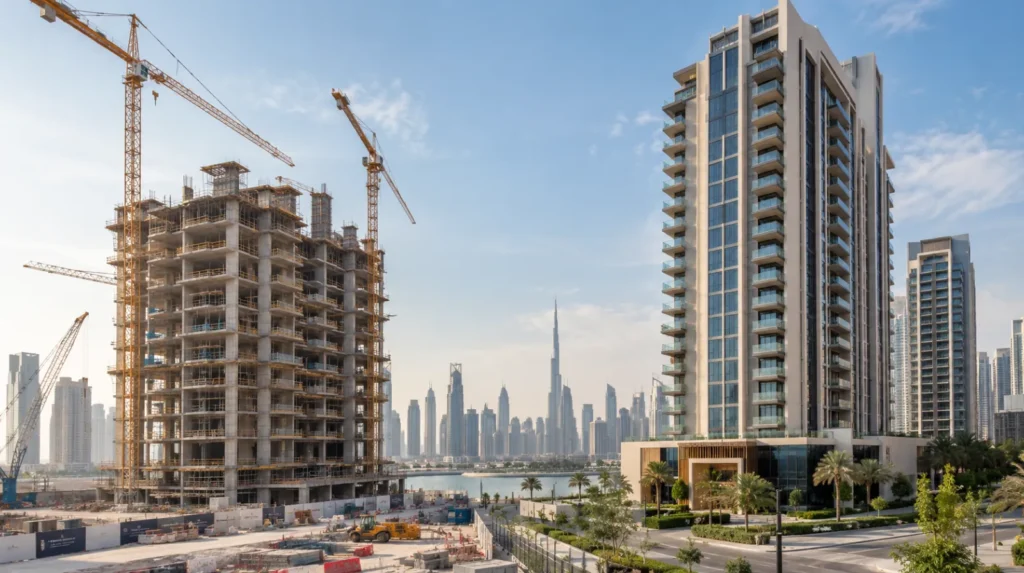
The easiest way to think about it is this: off-plan means you are buying a property that is still under development, while ready property means the unit already exists as a completed asset. In Dubai’s legal and administrative framework, those are not just marketing labels. They sit in different registration workflows. DLD explains that initial registration is used for off-plan real estate sales contracts and other legal actions before transfer to the real estate registry.
| Type | What you are buying | Main registration logic |
| Off-plan | A unit under construction | Interim Property Register / initial registration |
| Ready property | A completed property | Property sale registration and title deed transfer |
That distinction matters because the investor experience is different from day one. With off-plan, you are evaluating the project, developer, payment structure, and delivery path. With ready property, you are evaluating the actual completed asset and its transfer process.
Why Many Investors Choose Off-Plan
Off-plan is often the first choice for buyers who want more flexible capital deployment. Sky Paradise itself leans into this by promoting several payment plans and flexible ownership as part of Dubai’s appeal. For many investors, that is the main attraction: the ability to enter the market without paying the full amount upfront in a single step.
Off-plan usually makes more sense if you want:
- Staged payment plans instead of full immediate funding
- Access to new projects before completion
- More time between commitment and full capital outlay
- A developer-led buying structure rather than a completed resale-style transfer
There is also a legal point worth understanding. Dubai’s legal framework requires off-plan dispositions to be entered into the Interim Property Register, and DLD’s investor-rights material states that off-plan-related disposals must be registered there or they are considered void. That is one reason buyers should take project registration and developer process seriously.
Why Ready Property Appeals to Different Buyers
Ready property tends to appeal to investors who want immediate clarity. The building exists, the unit exists, and the transfer framework is easier for most buyers to understand. DLD’s sale registration process for individuals is clear that a non-resident foreign buyer can use a valid passport, and in freehold areas the process also requires an e-NOC from the developer.
Ready property is usually stronger if you want:
- A completed asset you can physically assess
- A more direct path to title transfer
- Immediate legal ownership evidence through a title deed
- A simpler fit for ownership-based administrative processes
This last point is especially important if residency planning matters to you. DLD’s investor residence and Golden Visa service pages both list an e-Certificate of Title / title deed among the required documents. That does not mean off-plan has no place in a long-term strategy, but it does mean ready property is usually the easier route if your planning horizon is shorter and document-backed ownership matters now.
Which Option Fits Which Investor?
A useful comparison is not “Which one is better?” but “Which one fits my objective better?”
| If your priority is… | Off-plan | Ready property |
| Flexible payment structure | Stronger fit | Usually weaker fit |
| Seeing the actual finished unit before buying | Weaker fit | Stronger fit |
| Immediate title-deed-based ownership evidence | Weaker fit | Stronger fit |
| Buying into a new development cycle | Stronger fit | Weaker fit |
This is why the two routes attract different mindsets. Off-plan is usually better for investors comfortable with development-stage timing and structure. Ready property is better for investors who want certainty, visibility, and immediate ownership formalities.
A Few Mistakes Buyers Should Avoid
A lot of buyers compare these two options too loosely. They focus only on brochure-level pricing or generic upside and ignore the operational reality of how each type is bought and registered.
The most common mistakes are:
- Treating off-plan and ready property as if they follow the same process
- Ignoring the legal importance of interim registration for off-plan units
- Assuming “fast registration” means the whole investment journey is fast
- Choosing a payment plan without thinking about when ownership proof will matter
Final Thought
For most investors, the decision is less about market hype and more about timing, structure, and what needs to happen after the purchase. Choose off-plan if you value payment flexibility and are comfortable with the development timeline. Choose ready property if you want a completed asset, clearer immediate ownership evidence, and a more straightforward fit for title-deed-based next steps. In Dubai, both routes can make sense. The smarter move is choosing the one that actually matches your investment logic.





One Response
Hi, this is a comment.
To get started with moderating, editing, and deleting comments, please visit the Comments screen in the dashboard.
Commenter avatars come from Gravatar.