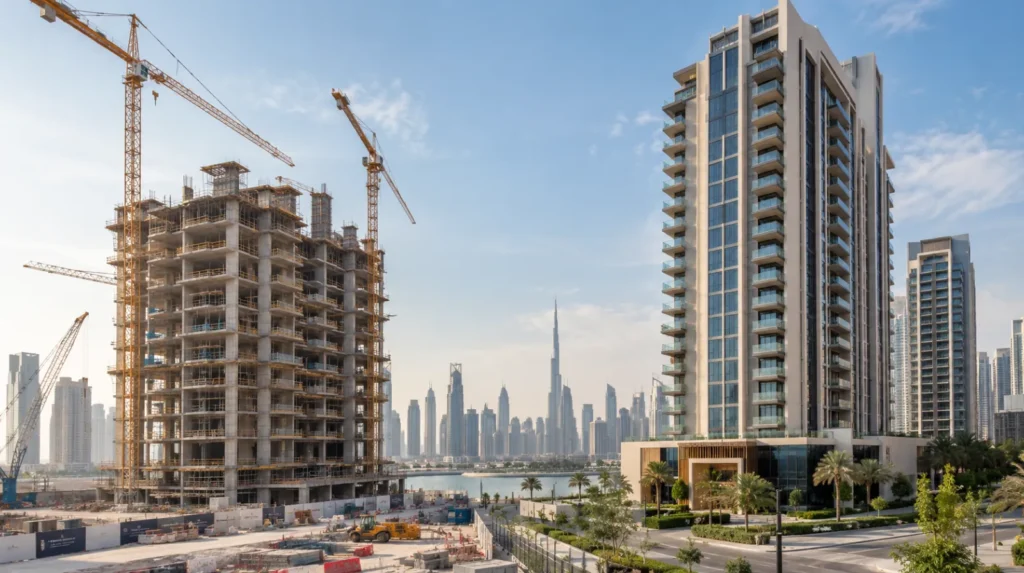
If a Dubai off-plan project is delayed, that does not automatically mean the buyer can walk away and recover the money immediately. The first thing that matters is whether the project is simply delayed, under cancellation review, or officially cancelled. Those are not the same situation. In practical terms, a delayed project usually requires verification, contract review, and sometimes court action, while an officially cancelled project moves into a liquidation and refund process under Dubai’s real estate framework.
Key Takeaways
- A delay is not the same as a cancellation.
- If a project is officially cancelled, the refund process moves into a regulated liquidation path.
- If the project is not cancelled and the buyer wants to recover amounts paid, the buyer usually has to go to court.
- Buyers have the right to verify actual construction progress when payments are linked to completion milestones.
- Project status, escrow details, and payment obligations can be checked through official Dubai systems.
- The smartest next step depends on the project’s legal status, not just the developer’s message.
Start With the Most Important Question: Delayed, Under Cancellation, or Cancelled?
A lot of buyers panic too early, or wait too long, because they do not separate these three situations.
| Project status | What it usually means | What the buyer should do first |
| Delayed | The project is still active, but progress is slower than expected | Verify project status and milestone progress |
| Under cancellation | The project is going through review and procedural steps | Monitor status closely and prepare documents |
| Cancelled | A formal cancellation decision has been issued | Follow the liquidation and refund path |
This distinction matters because your legal and practical options change depending on which stage the project is in.
What to Do If the Project Is Delayed
If the project is delayed but not cancelled, the first step is verification, not assumption. Buyers should not rely only on informal updates from brokers or sales teams.
Start by checking:
- the official project status
- the project’s completion percentage
- whether payment requests match actual construction progress
- whether the project is still moving through the expected registration framework
If your SPA links payments to construction milestones, the key question is whether the project has actually reached the required stage. If it has not, that changes how you should approach the next installment.
What If the Developer Asks for Payment During a Delay?
This is one of the most important practical issues in delayed off-plan projects.
If the payment schedule is tied to construction stages, the buyer should verify whether the project has genuinely reached the milestone being used to justify the demand.
Before paying the next installment, check:
- whether the completion percentage supports the payment request
- whether the payment trigger in the SPA is clearly tied to that stage
- whether the project status in official systems matches what you are being told
- whether there is any growing sign that the project may move toward cancellation review
This is where many buyers make a costly mistake: they treat every payment demand as automatic, even when project progress is unclear.
What Happens If the Project Is Officially Cancelled?
Once a Dubai off-plan project is officially cancelled, the situation changes materially. At that point, the process moves away from ordinary project delay and into liquidation and refund handling.
In practical terms, that usually means:
- the project moves into the liquidation framework
- the financial position of the project is reviewed
- escrow-related funds and paid amounts are examined
- a refund process begins according to the cancellation path
This is why buyers should never confuse “serious delay” with “formal cancellation.” The rights and procedures are not identical.
How Refunds Usually Work After Cancellation
In a cancelled-project scenario, the core issue becomes recovery of paid amounts.
A practical way to think about the refund path is this:
| Situation | Typical next step |
| Officially cancelled project | Liquidation and refund process starts |
| Escrow funds are enough | Refund distribution can move through the project’s financial review process |
| Escrow funds are not enough | The developer may still be required to refund buyers within the relevant framework |
| Developer does not comply | The matter can move toward court action |
The important point is that cancellation does not mean “nothing happens.” It means the case enters a structured process. But it may still take time, especially where the available funds are insufficient.
What If the Project Is Not Cancelled, but You Want Out?
This is where many buyers misunderstand their position. If the project is not cancelled and the buyer simply wants to recover the money paid, that is usually no longer a pure project-status issue. It becomes a contractual dispute.
That means the buyer should stop thinking only in terms of “delay” and start thinking in terms of:
- SPA termination rights
- breach and default provisions
- whether the developer has failed at a legally meaningful level
- whether court action is necessary
In short, if the project is still legally alive, the buyer usually cannot assume an automatic refund route.
What Official Tools Should You Use First?
Before escalating, buyers should collect verified facts.
The most useful starting points are:
- official project-status tools
- Dubai REST project information
- the SPA and payment schedule
- Oqood / provisional registration records
- proof of payments already made
These tools help answer the questions that matter most:
- Is the project still active?
- Is it progressing?
- Is it under cancellation review?
- What has already been paid?
- What stage has legally been reached?
Without those facts, buyers often escalate too early, or in the wrong direction.
Common Mistakes Buyers Make
The most common mistakes in delayed off-plan cases are not legal. They are practical.
Buyers often get into trouble by:
- assuming delay automatically equals cancellation
- continuing to pay without checking milestone progress
- relying on verbal reassurances instead of official status tools
- ignoring the SPA’s delay, breach, and termination clauses
- waiting too long before collecting documents and payment proof
A delayed project is already stressful. Poor record-keeping makes it worse.
Final Thought
If a Dubai off-plan project is delayed, the smartest response is not panic and not blind patience. It is classification. First find out whether the project is delayed, under cancellation, or officially cancelled. Then match your next step to that reality. If it is delayed, verify progress and review your SPA. If it is cancelled, move into the refund and liquidation path. If it is not cancelled and you want out anyway, you are usually dealing with a court-driven contractual dispute rather than an automatic refund process.