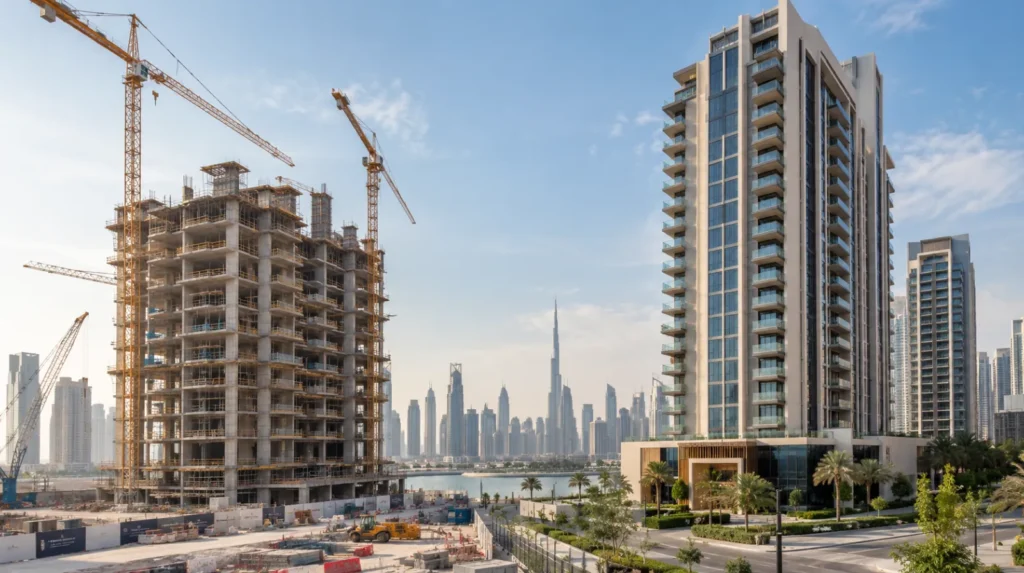
If you are buying property in Dubai for investment, checking today’s rent and price is not enough. You also need to know how many competing homes may enter the market before you plan to rent or resell your property. Oversupply risk does not mean Dubai as a whole has too many properties. It usually appears at a much smaller level: a specific community, building cluster, property type, or unit size where new supply grows faster than tenant and buyer demand.
Key Takeaways
- Do not judge oversupply from a Dubai-wide supply number alone.
- Check upcoming projects and construction progress around the exact property you are considering.
- Compare future supply with actual rental and sales activity.
- Pay attention to the number of similar units, not just total homes being delivered.
- A community can absorb substantial new supply if tenant and end-user demand is growing with it.
- High future supply becomes more concerning when combined with weak rents, heavy landlord competition, and identical investor-owned units.
- Analyze the market at the community + property type + bedroom level whenever possible.
What Does Oversupply Risk Actually Mean?
Oversupply happens when the number of properties available to tenants or buyers grows faster than demand can absorb them.
For an investor, that may lead to:
- longer vacancy periods
- more competition between landlords
- rent incentives or lower asking rents
- slower resale
- greater price competition
- weaker short-term capital appreciation
But new construction alone does not equal oversupply.
A community receiving 5,000 new homes may absorb them successfully if its population, infrastructure, employment access, and tenant demand are growing rapidly. Another location may struggle with a much smaller pipeline if there is limited demand.
Why Dubai-Wide Supply Numbers Can Be Misleading
Dubai is not one residential market.
Demand for a studio near a business district is different from demand for a family villa in a suburban master community. Even two neighboring apartment developments may have very different tenant profiles.
A better analysis moves through three levels:
| Level | What to Check |
| Dubai | Overall market direction and major supply trends |
| Community | New projects, rental demand, infrastructure, existing stock |
| Unit type | Number of competing studios, 1BRs, villas, etc. |
The closer you get to the exact property, the more useful the analysis becomes.
Step 1: Map the Future Supply Around the Property
Start by identifying developments that could compete with your investment during your expected holding period.
Dubai Land Department provides tools such as Project Status, Dubai Projects, and Dubai REST that allow investors to check registered projects and monitor construction progress.
Look for:
- active developments in the same community
- estimated completion periods
- current construction progress
- recently completed buildings
- projects entering handover within the next 12–36 months
- large master-plan phases that may add substantial inventory
Do not count every announced project as guaranteed future supply. Construction progress matters because scheduled completion and actual delivery are not always the same.
Step 2: Count Competing Units, Not Just Projects
Twenty new projects sounds alarming until you understand what they contain.
If most upcoming supply consists of studios and one-bedroom apartments, the impact on a three-bedroom family unit may be limited.
Ask:
- How many units are being delivered?
- What percentage are studios or one-bedrooms?
- How many competing units have similar layouts and price points?
- Are most units investor-owned?
- Are several developers targeting the same tenant segment?
Similarity creates competition.
A distinctive two-bedroom apartment in a family-oriented community may face less direct competition than one of hundreds of nearly identical studios delivered at the same time.
Step 3: Compare Supply With Real Tenant Demand
Future supply only becomes meaningful when compared with demand.
Dubai Land Department’s real estate data allows investors to review registered rental activity by area and property characteristics.
Useful demand signals include:
- number of tenancy transactions
- renewal activity
- achievable annual rent
- rental growth or stagnation
- time properties remain available
- occupancy in existing buildings
- tenant profile
A healthy community should demonstrate actual leasing activity—not only investor sales.
That distinction becomes particularly important in heavily off-plan areas where strong sales can exist before a mature rental market has formed.
Step 4: Check How Much Competition Already Exists
Future handovers are only half of the picture.
Before buying, search existing buildings in the same micro-market and see how many similar properties are already competing for tenants.
For example, if you are considering a one-bedroom apartment, compare:
- available one-bedroom rental listings
- asking rents
- recent achieved rents
- number of similar layouts
- furnished vs. unfurnished competition
- recently completed buildings nearby
A large number of landlords repeatedly reducing rents or offering incentives can indicate that supply is already putting pressure on the market.
Step 5: Understand Who Will Absorb the New Homes
The strongest protection against oversupply is real demand.
Ask why someone would live in this location.
Demand may be supported by:
- proximity to employment centers
- schools and family infrastructure
- transport connectivity
- retail and lifestyle amenities
- established community services
- relative affordability
- limited competing property types
A project should not depend entirely on future promises. The more existing demand drivers already operating around the property, the easier it is to evaluate the investment.
A Simple Oversupply Risk Scorecard
Before buying, rate each factor from low to high risk.
| Factor | Lower Risk | Higher Risk |
| Upcoming supply | Limited competing stock | Large concentration of similar units |
| Construction timing | Deliveries spread over time | Many simultaneous handovers |
| Rental demand | Strong transaction activity | Weak leasing activity |
| Unit differentiation | Scarce or distinctive | Highly standardized |
| Tenant base | Multiple tenant segments | Narrow tenant segment |
| Existing competition | Limited availability | Many similar listings |
| Infrastructure | Already established | Mostly future promises |
No single factor should decide the purchase. The combination matters.
Common Mistakes Investors Make
The most common mistakes are:
- treating all future projects as guaranteed deliveries
- looking only at total Dubai supply
- ignoring the bedroom mix of upcoming developments
- using property sales as proof of tenant demand
- overlooking competing landlord listings
- assuming population growth will benefit every community equally
- buying solely because an area is currently popular
- ignoring what will be completed before the investor plans to exit
Oversupply risk is usually visible before it affects returns—but only if the investor looks forward instead of relying on current performance.
Final Thought
The best Dubai property is not necessarily located in the community with the least construction. Growing areas need new supply.
The real question is whether future demand is likely to absorb future competing supply at the price and rent your investment requires.
Before buying, map upcoming handovers, identify directly competing units, verify rental activity, understand the tenant base, and study existing landlord competition. A strong investment should not only perform in today’s market. It should still make sense when the buildings currently under construction open their doors.